
In the world of forex trading, utilizing effective indicators is crucial for making informed decisions. While there are numerous indicators available, selecting the right ones can greatly enhance your trading experience. If you’re looking for a reliable source of information on forex trading, visit best indicators for forex trading Trading Platform VN for valuable insights and resources.
Understanding Forex Indicators
Forex indicators are tools that traders use to analyze market data and predict future price movements. These indicators rely on statistical calculations and can help traders identify trends, reversals, and potential entry or exit points. In this article, we will explore the best indicators for forex trading to guide you towards more profitable trades.
1. Moving Averages
Moving averages are among the most popular indicators used in forex trading. They smooth out price data over a specified period, enabling traders to identify trends and potential reversal points. The two most common types are:
- Simple Moving Average (SMA): This is calculated by taking the average price of a currency pair over a specific number of periods. For example, a 20-period SMA calculates the average of the last 20 closing prices.
- Exponential Moving Average (EMA): This type of moving average gives more weight to recent prices, making it more responsive to price changes. Traders often use the EMA to identify short-term trends.
Traders often use these moving averages in combination to spot potential buy or sell signals. A common crossover strategy involves buying when a shorter-term EMA crosses above a longer-term SMA and selling when it crosses below.
2. Relative Strength Index (RSI)
The Relative Strength Index (RSI) is a momentum oscillator that measures the speed and change of price movements. The RSI is displayed on a scale of 0 to 100 and is typically considered overbought when above 70 and oversold when below 30.
Traders use the RSI to identify potential reversal points. For example, if the RSI reaches an overbought condition, it could signal a price correction is imminent. Conversely, an oversold condition may indicate a potential upward reversal.
3. Moving Average Convergence Divergence (MACD)
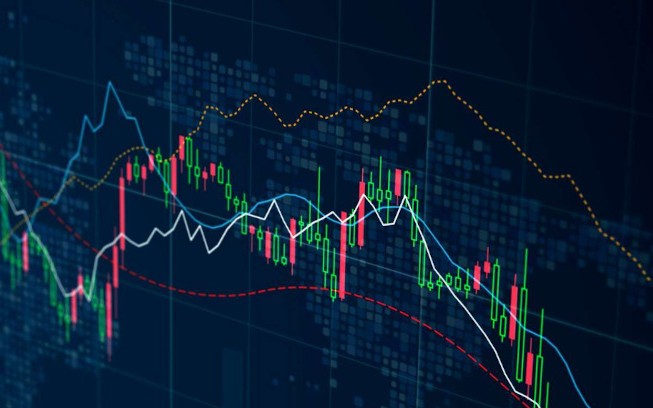
The Moving Average Convergence Divergence (MACD) is a popular trend-following momentum indicator. It comprises two moving averages: the MACD line and the signal line. Additionally, it includes a histogram that displays the difference between these two lines.
Traders often look for crossovers between the MACD line and the signal line to generate buy or sell signals. When the MACD line crosses above the signal line, it indicates a potential buying opportunity, while a crossover below the signal line signals a potential sell.
Moreover, the histogram can provide insights into the strength of the trend. A widening histogram suggests a strengthening trend, while a narrowing histogram may indicate a reversal.
4. Bollinger Bands
Bollinger Bands are a volatility indicator created by overlaying two standard deviation lines above and below a moving average. The distance between the bands fluctuates based on market volatility. When the bands are far apart, it indicates high volatility, while close bands suggest low volatility.
Traders commonly use Bollinger Bands to identify overbought or oversold conditions. When the price touches the upper band, it may signal a potential reversal to the downside. Conversely, when the price touches the lower band, it could indicate a potential upward reversal.
5. Fibonacci Retracement Levels
Fibonacci retracement levels are widely used by forex traders to identify potential support and resistance levels based on the Fibonacci sequence. Traders typically identify significant price levels and plot horizontal lines at the key Fibonacci levels of 23.6%, 38.2%, 50%, 61.8%, and 100%.
Market participants observe these levels to anticipate potential price reversals. A price retracing to the 61.8% level, for instance, might signify a strong support level for a potential upward bounce.
6. Stochastic Oscillator
The Stochastic Oscillator is a momentum indicator that compares a particular closing price of a currency pair to its price range over a specified period. The indicator is represented with two lines: the %K line (fast line) and the %D line (slow line).

Similar to the RSI, the Stochastic Oscillator operates on a scale of 0 to 100. Readings above 80 indicate overbought conditions, while readings below 20 indicate oversold conditions. Traders often use crossovers between the %K and %D lines to enter or exit trades.
7. Average True Range (ATR)
The Average True Range (ATR) is a volatility indicator used to measure market volatility by decomposing the entire range of an asset price for that period. The ATR does not indicate price direction but rather the average volatility within a certain timeframe.
Traders may use the ATR to determine the best stop-loss levels, as a higher ATR value suggests wider price movements and, therefore, a greater need for larger stop-loss orders.
8. Ichimoku Cloud
The Ichimoku Cloud is a comprehensive indicator that defines support and resistance, identifies trend direction, and provides trading signals. It consists of five main components:
- Tenkansen (Conversion Line): The average of the highest high and the lowest low over the last 9 periods.
- Kijunsen (Base Line): The average of the highest high and lowest low over the last 26 periods.
- Senkou Span A and B (Leading Span): These lines create a “cloud” that predicts future support and resistance levels.
- Chikou Span (Lagging Line): The closing price plotted 26 periods back.
Traders use the cloud to determine trend direction: if the price is above the cloud, the trend is considered bullish, while a price below the cloud indicates a bearish trend.
Conclusion
Using the right indicators can significantly improve your forex trading strategy. While each of the indicators discussed has its strengths and weaknesses, combining them can provide a more comprehensive view of the market. Always remember that no indicator is perfect; therefore, it’s essential to complement your analysis with sound risk management practices.
Stay informed, practice regularly, and utilize these indicators to enhance your trading decisions. Happy trading!